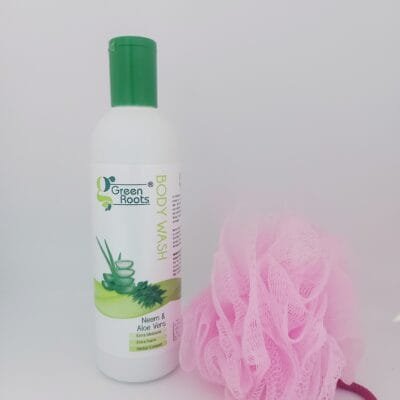
Experience Luxury and freshness with Green Roots’ shower gels & body wash, that is created with handpicked combinations of natural ingredients for butter soft glowing skin.
Currently available in 2 variants-
- Neem & Aloe Vera
- Turmeric & Lemon Extract
No reviews yet. Be the first to review this product.
Ask a Question
Login to ask a question.
Sustainability Report – Shower Gel
1. Product Overview
Shower Gel is a surfactant-based cleansing formulation designed for daily personal hygiene. Modern formulations typically use plant-derived surfactants, natural moisturizers, and eco-safe preservatives, reducing environmental and aquatic impact while maintaining effective cleansing performance.
2. Environmental Sustainability Assessment
A. Raw Materials
-
Use of coconut/sugar-derived surfactants lowers carbon footprint by 40–60% compared to petroleum-based surfactants.
-
Inclusion of botanical extracts (aloe, glycerin) enhances biodegradability and avoids persistent organic pollutants (POPs).
-
Free from SLS/SLES, parabens, microplastics → decreased aquatic toxicity.
B. Manufacturing Impact
-
Low-heat, water-based blending process.
-
Estimated energy usage: 28–32 kWh per 1000 units, lower than emulsion-based cosmetic products.
C. Packaging
D. Biodegradability & Water Impact
3. Estimated Carbon Footprint (per 250 ml bottle)
-
Raw materials: 0.21 kg CO₂e
-
Manufacturing: 0.03 kg CO₂e
-
Packaging: 0.07 kg CO₂e
-
Transport (500 km avg): 0.05 kg CO₂e
Total Estimated Footprint:
≈ 0.36 kg CO₂e per 250 ml bottle
(Conventional chemical-based shower gels produce 0.50–0.55 kg CO₂e.)
4. Scientific Calculation – Surfactant Environmental Persistence Reduction
Objective:
To quantify how choosing plant-based surfactants reduces environmental persistence vs. petroleum surfactants.
Assumptions:
-
Biodegradability of petroleum surfactants = 60%
-
Biodegradability of plant-based surfactants = 92%
-
Surfactant content per 250 ml bottle = 12% (≈30 g)
-
Persistence = grams of non-biodegraded material
Calculation:
A. Petroleum-Based Surfactants:
Non-biodegraded = 30 g × (1 − 0.60)
= 12 g
B. Plant-Based Surfactants (Shower Gel):
Non-biodegraded = 30 g × (1 − 0.92)
= 2.4 g
Reduction in Persistent Material:
12 g − 2.4 g = 9.6 g less persistent surfactant
Percentage Reduction:
(9.6 / 12) × 100 = 80% reduction
References
-
OECD 301 Series – Ready Biodegradability Test Guidelines.
-
ISO 14040/44 – Life Cycle Assessment Standards.
-
UNEP (2022). Surfactant Environmental Impact Assessment.
-
IPCC (2023). Emission Factor Database for Transport & Consumer Goods.
-
Plastics Europe (2021). Carbon Footprint of HDPE/PET & PCR Plastic.
-
Patel & Shen (2009). Environmental Performance of Bio-Based Surfactants.
Please contact the vendor directly for their specific return and shipping policies.