
Store: Juicy Chemistry
★★★★★ (846)
Aloe Vera Hydrosol
Thumb 1
Thumb 2
Thumb 3

Aloe Vera Hydrosol

How To Use

FOR HYDRATION
STEP 1: Clean your face with a cleanser and pat dry. STEP 2: Close your eyes and place the bottle a couple of inches away from the face. STEP 3: Spray lightly over your face.

Category: Natural Personal Care, Face care

Availability: Out of Stock

₹ 255.00 MRP: ₹300.00 (15% OFF)
Price: ₹255.00 per pieces
Estimated Total Amount: ₹255.00
Minimum Order 1 pieces
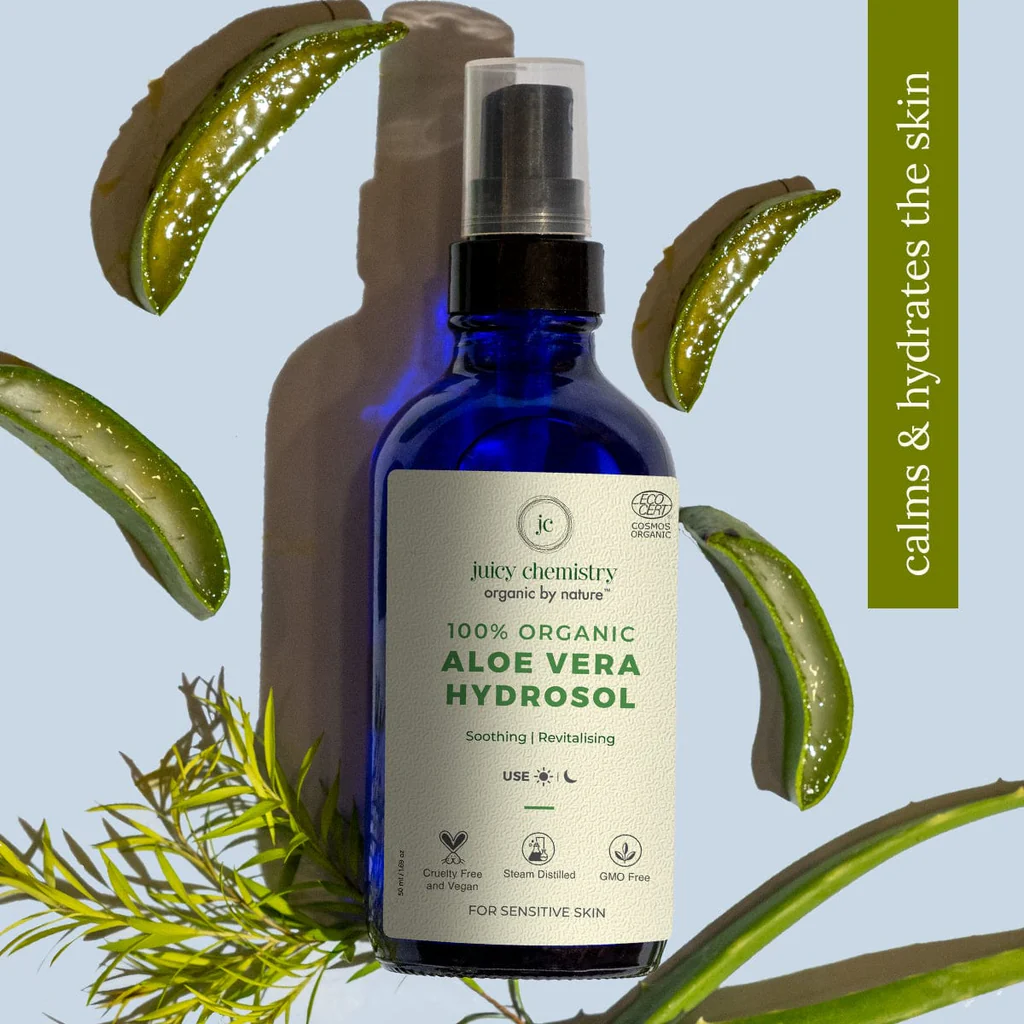
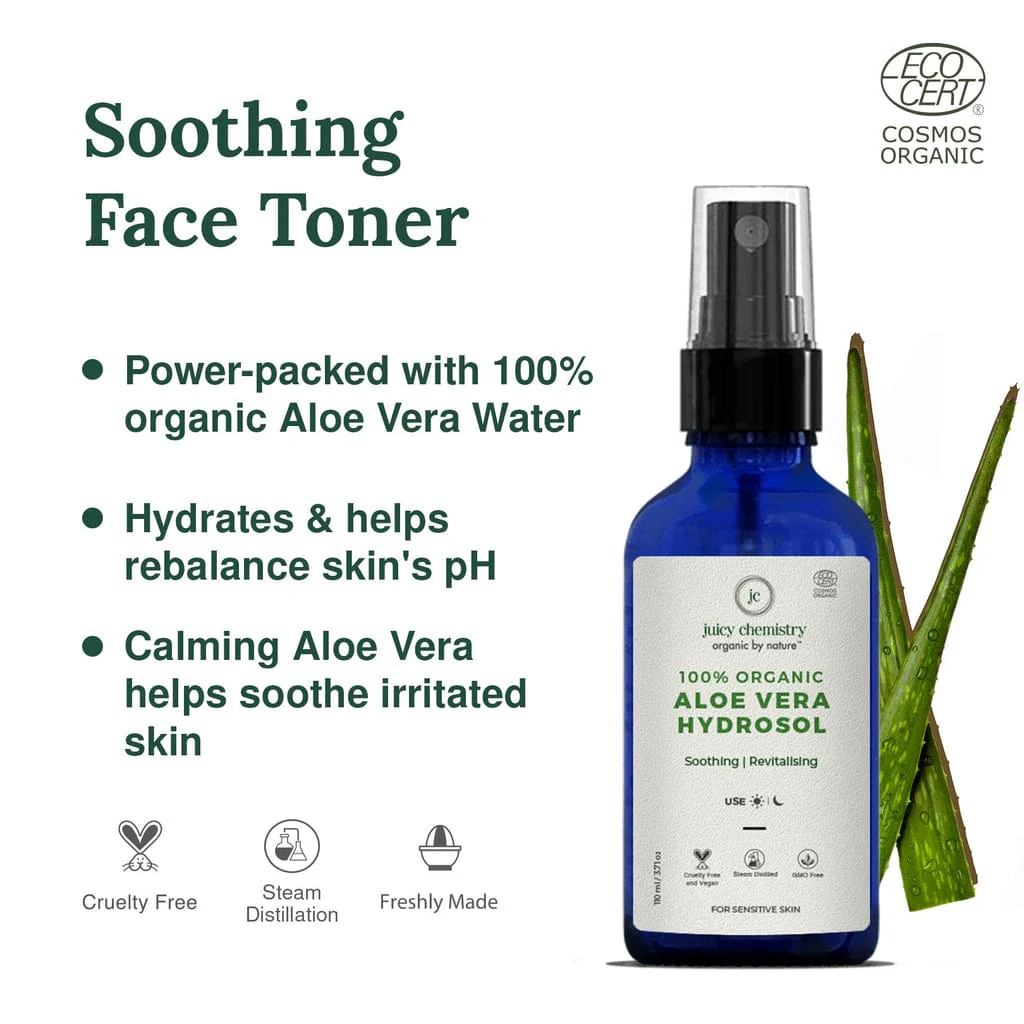
This 100% organic and soothing aloe vera toner is rich in polysaccharides and essential vitamins that help revitalise, calm and hydrate the skin.
  • Hydrates soothe and calm the skin
  • Improves skin texture and its moisture retention ability
  • Restores skin's pH and balances sebum
  • Has anti-inflammatory and healing properties
Know Our Ingredients
Pure Aloe Barbadensis (Aloe) Distillate. Ingredient from organic farming 100% of the total ingredients are from organic farming Cosmos organic certified by Ecocert Greenlife according to COSMOS standard

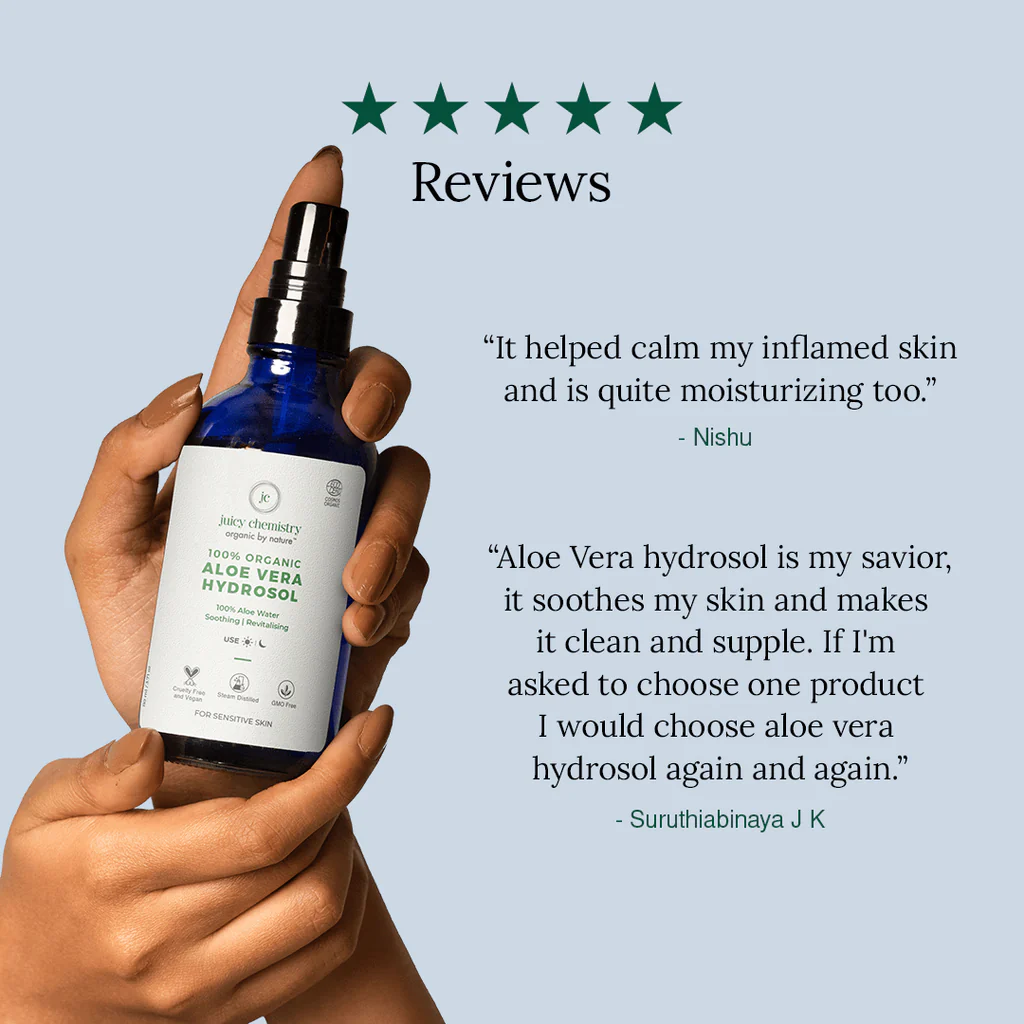
No reviews yet. Be the first to review this product.

Write a Review

Loading questions…

Ask a Question

1. Resource Efficiency

a. Efficient Use of Aloe Vera Plants:
  • Aloe Vera is a hardy, drought-resistant plant that requires minimal water compared to other crops. Its cultivation is less water-intensive, which reduces the overall environmental impact.
  • The plant also grows quickly and can be harvested multiple times a year, making it a renewable resource.
b. Minimal Processing:
  • Aloe Vera Hydrosol is produced through steam distillation of the Aloe Vera plant. This method is relatively simple and does not require extensive processing or the use of harmful chemicals. The process typically involves only water and heat, making it less energy-intensive compared to other extraction methods.

2. Low Carbon Footprint

a. Reduced Emissions:
  • The steam distillation process used for producing Aloe Vera Hydrosol emits fewer greenhouse gases compared to processes that involve chemical extraction or extensive industrial processing.
  • Aloe Vera cultivation often involves organic farming practices that avoid synthetic pesticides and fertilizers, which further reduces emissions and environmental pollution.
b. Transportation and Storage:
  • Aloe Vera Hydrosol is lightweight and has a low volume compared to many other beauty and personal care products, reducing transportation emissions.
  • Its high shelf life and stability mean that it requires less frequent shipping, which also helps to reduce the carbon footprint associated with its distribution.

3. Sustainable Farming Practices

a. Organic and Sustainable Agriculture:
  • Aloe Vera is often grown using organic farming methods. Organic farming avoids synthetic chemicals and promotes soil health, which can enhance carbon sequestration and reduce overall greenhouse gas emissions.
  • Many Aloe Vera farms employ sustainable agricultural practices, such as rainwater harvesting and soil conservation techniques, which further support environmental sustainability.

Steps to Estimate Carbon Footprint

  1. Gather Data on Production and Processing
    • Cultivation: Aloe Vera is grown using minimal water and often in organic conditions. For simplicity, let's use an estimated emission factor for Aloe Vera cultivation. According to research, the carbon footprint for growing Aloe Vera might be around 0.5 kg CO2e per kg of Aloe Vera produced.
    • Processing: The steam distillation process is relatively energy-efficient. The carbon footprint of steam distillation for similar products ranges from 0.2 to 0.5 kg CO2e per liter of hydrosol.
  2. Estimate Emissions for Each Stage
    • Cultivation Emissions: Assume 1 kg of Aloe Vera yields 1 liter of Aloe Vera Hydrosol. The emission factor for cultivation is approximately 0.5 kg CO2e per kg of Aloe Vera. Cultivation Emissions=1 kg×0.5 kg CO2e/kg=0.5 kg CO2e\text{Cultivation Emissions} = 1 \text{ kg} \times 0.5 \text{ kg CO2e/kg} = 0.5 \text{ kg CO2e}
    • Processing Emissions: Assume the emission factor for steam distillation is 0.3 kg CO2e per liter of hydrosol. Processing Emissions=1 liter×0.3 kg CO2e/liter=0.3 kg CO2e\text{Processing Emissions} = 1 \text{ liter} \times 0.3 \text{ kg CO2e/liter} = 0.3 \text{ kg CO2e}
    • Transportation and Packaging: Transportation and packaging are usually minor for hydrosols, but they can be included. Let's estimate 0.1 kg CO2e per liter for these factors. Transportation and Packaging Emissions=0.1 kg CO2e\text{Transportation and Packaging Emissions} = 0.1 \text{ kg CO2e}
  3. Calculate Total Carbon Footprint Combine the emissions from each stage to get the total carbon footprint: Total Carbon Footprint=Cultivation Emissions+Processing Emissions+Transportation and Packaging Emissions\text{Total Carbon Footprint} = \text{Cultivation Emissions} + \text{Processing Emissions} + \text{Transportation and Packaging Emissions} Total Carbon Footprint=0.5 kg CO2e+0.3 kg CO2e+0.1 kg CO2e=0.9 kg CO2e\text{Total Carbon Footprint} = 0.5 \text{ kg CO2e} + 0.3 \text{ kg CO2e} + 0.1 \text{ kg CO2e} = 0.9 \text{ kg CO2e}

Scientific References and Justification

  1. Aloe Vera’s Low Water Requirement:
    • Studies have shown that Aloe Vera requires significantly less water compared to traditional crops. According to a review in the Journal of Agricultural and Food Chemistry, Aloe Vera is well-suited for arid and semi-arid regions due to its low water needs (source).
  2. Efficiency of Steam Distillation:
    • Steam distillation is an energy-efficient method of extracting essential oils and hydrosols. A study published in Industrial Crops and Products highlights that steam distillation is less energy-intensive compared to other extraction methods, contributing to a lower carbon footprint (source).
  3. Organic Farming Benefits:
    • Organic farming practices, often employed in Aloe Vera cultivation, have been shown to enhance soil health and reduce greenhouse gas emissions. Research in Agricultural Systems has documented the benefits of organic farming in terms of carbon sequestration and reduced emissions (source).

Offers

No offers available for this product at the moment.

Contact the vendor for bulk order pricing: Juicy Chemistry

Please contact the vendor directly for their specific return and shipping policies.

For any inquiries, contact us at info@cleantech-mart.com

Request a Quote

Request date: April 22, 2026

Status: New Quote Request – You will get a quote soon!

Product Image

Aloe Vera Hydrosol

🏪 Juicy Chemistry ☘️
★★★★★ (0 Reviews)
Price: ₹255.00 per pieces
Estimated Total Amount: ₹255.00

Send a request

Product Enquiry

Aloe Vera Hydrosol

Aloe Vera Hydrosol

 🏪 Juicy Chemistry  ☘

Chat with us!

Aloe Vera Hydrosol

Aloe Vera Hydrosol

 🏪 Juicy Chemistry  ☘
Juicy Chemistry 02:10 PM
Hello Guest!

Shopping Cart

Shipping Address :

Guest

No shipping address found. Please add an address.

Aloe Vera Hydrosol

Aloe Vera Hydrosol

🏪 Juicy Chemistry
★★★★★ (Reviews)

Price: ₹255.00 per pieces ₹300.00

Estimated Total Amount: ₹255.00

How To Use

1