

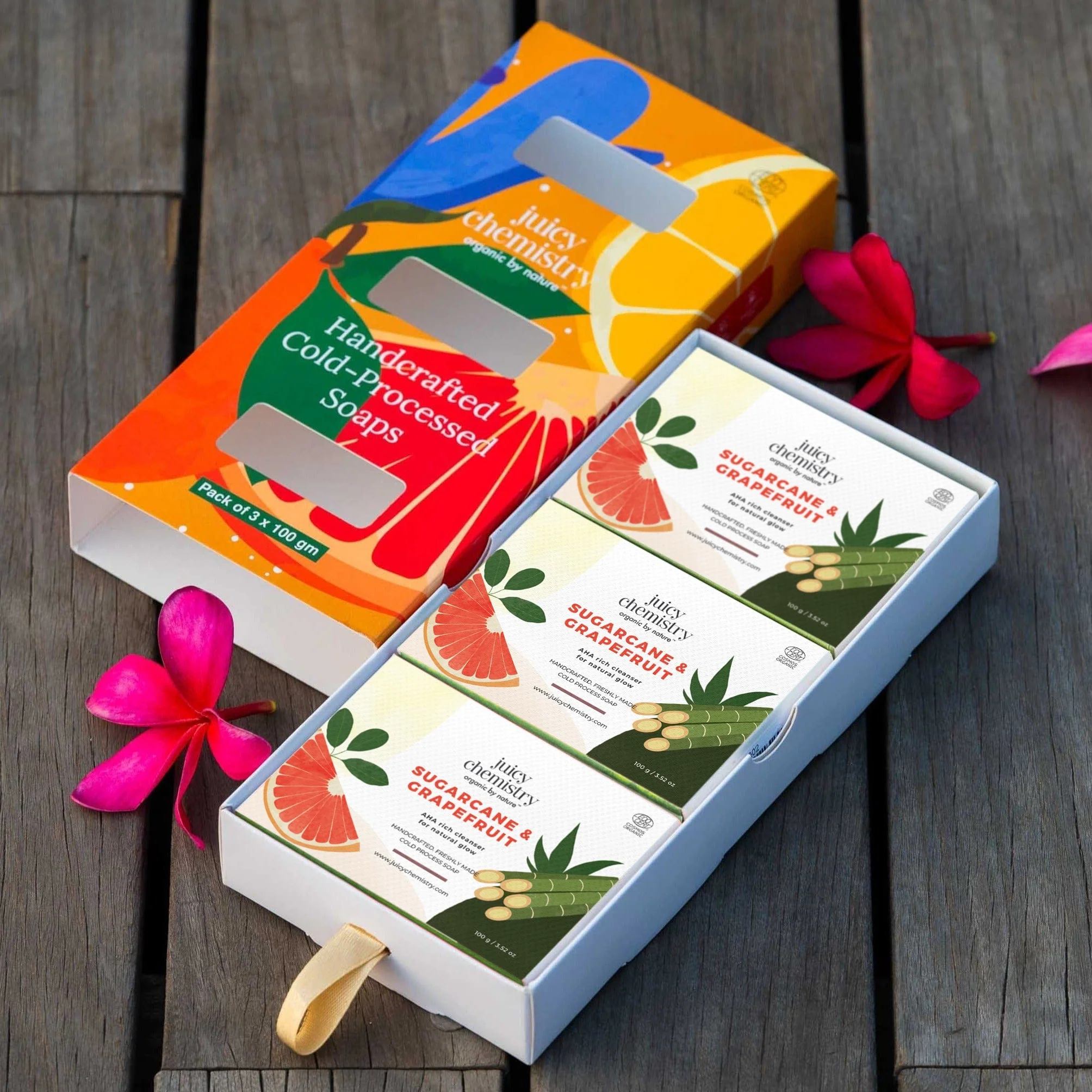

Store: Juicy Chemistry
★★★★★ (846)
Sugarcane And Grapefruit Soap
Thumb 1
Thumb 2
Thumb 3

Sugarcane And Grapefruit Soap

How To Use

STEP 1:
Rub the soap between your palms and work up a lather. STEP 2: Spread lather on your wet face and body with gentle strokes. STEP 3: Scrub your body gently with JC's Bath Mitt (twice a week only).

Category: Natural Skin Care, Soap and Shampo Bar

Availability: Out of Stock

₹ 405.00 MRP: ₹500.00 (19% OFF)
Price: ₹405.00 per pieces
Estimated Total Amount: ₹405.00
Minimum Order 1 pieces
This organic AHA-rich soap bar gently cleanses the skin and helps promote both more even-toned skin and smoother skin texture. It is suitable for Normal to Oily skin. Key Benefits
  • Deep cleanses and removes impurities from pores
  • Promotes more even-toned skin
  • Improves the skin's texture
  • Boosts the skin’s ability to absorb nutrients
  • Preserves the skin’s natural moisture
Know Our Ingredients
Sodium Cocoate, Sodium Oliviate, Saccharum Officinarum (Sugarcane) Extract, DM Water (Aqua), Sodium Shea Butterate, Sodium Castorate, Citrus Paradisi (Grapefruit) Oil, Pogostemon Cablin (Patchouli) Oil. Saponified oils of Olive, Coconut and Castor. Ingredient from Organic Farming Made using Organic Ingredients Lye is used during saponification process, none remains in the final product. 100% natural origin of total

No reviews yet. Be the first to review this product.

Write a Review

Loading questions…

Ask a Question

1. Ingredients Sourcing

Sugarcane:
  • Renewable Resource: Sugarcane is a renewable resource because it grows quickly and can be harvested multiple times a year. Unlike finite resources like fossil fuels, it can be regrown in a relatively short period, reducing the impact on the environment.
  • Carbon Sequestration: During its growth, sugarcane absorbs significant amounts of CO₂ from the atmosphere, which helps mitigate climate change. This process of carbon sequestration can offset a portion of the carbon emissions associated with its cultivation and processing.
Grapefruit:
  • Agricultural Benefits: Grapefruit is typically grown in tropical and subtropical regions, which often have abundant sunlight and can be less resource-intensive in terms of water and energy compared to other crops. When cultivated sustainably, the carbon footprint of grapefruit production can be relatively low.

2. Production Process

  • Low Energy Consumption: The process of making soap from natural ingredients like sugarcane and grapefruit usually involves lower energy consumption compared to synthetic alternatives. Traditional cold-process soap making, for instance, requires less energy than some commercial methods.
  • Minimal Processing: Natural soap-making often uses less intensive processing methods. For example, the cold process method, which involves mixing fats (like those from sugarcane) with lye and water, avoids the high temperatures and chemical treatments required in some other methods.

3. Environmental Impact

  • Biodegradability: Natural soaps like those made with sugarcane and grapefruit are biodegradable, meaning they break down naturally and are less likely to contribute to long-term environmental pollution compared to synthetic soaps. This reduces their impact on aquatic ecosystems and soil health.
  • Reduced Synthetic Ingredients: By avoiding synthetic chemicals and artificial fragrances, natural soaps reduce the risk of environmental contamination. Synthetic ingredients can sometimes accumulate in ecosystems, causing harm to wildlife and disrupting natural processes.

4. Packaging and Distribution

  • Sustainable Packaging: Many natural soap products use eco-friendly packaging, such as recyclable or compostable materials, which helps reduce waste. The carbon footprint can be further minimized if the packaging is sourced sustainably.
  • Local Sourcing and Distribution: If sugarcane and grapefruit are sourced locally, transportation emissions are reduced. Local sourcing helps minimize the carbon footprint associated with the logistics of bringing ingredients to manufacturing facilities.

1. Raw Material Production

Sugarcane:
  • CO₂ Sequestration: Sugarcane absorbs approximately 1.7 kg of CO₂ per kg of sugarcane.
  • Cultivation Emissions: Estimated at about 0.4 kg CO₂ per kg of sugarcane produced (includes emissions from fertilizer, irrigation, etc.).
Grapefruit:
  • Cultivation Emissions: Around 0.3 kg CO₂ per kg of grapefruit.
Total for Raw Materials: Let's assume 0.5 kg of sugarcane and 0.2 kg of grapefruit per bar of soap (100g):
  • Sugarcane CO₂ Sequestration: 0.5 kg × 1.7 kg CO₂/kg = 0.85 kg CO₂ absorbed
  • Sugarcane Emissions: 0.5 kg × 0.4 kg CO₂/kg = 0.20 kg CO₂
  • Grapefruit Emissions: 0.2 kg × 0.3 kg CO₂/kg = 0.06 kg CO₂
Total Raw Materials CO₂: Total=0.20 kg+0.06 kg−0.85 kg (sequestered)=−0.59 kg CO₂\text{Total} = 0.20 \text{ kg} + 0.06 \text{ kg} - 0.85 \text{ kg (sequestered)} = -0.59 \text{ kg CO₂} (negative value indicates CO₂ sequestration offsets cultivation emissions)

2. Production Process

Energy Use:
  • Cold Process Soap Making: Approximately 0.1 kg CO₂ per kg of soap.
For 100g of soap: Production CO₂=0.1 kg CO₂/kg×0.1 kg=0.01 kg CO₂\text{Production CO₂} = 0.1 \text{ kg CO₂/kg} \times 0.1 \text{ kg} = 0.01 \text{ kg CO₂}

3. Transportation

Transportation Emissions:
  • Assumption: Average transportation emission is 0.05 kg CO₂ per bar of soap, considering distribution from manufacturer to retailer and consumer.

4. Packaging

Packaging Emissions:
  • Assumption: Packaging adds approximately 0.02 kg CO₂ per bar of soap.

5. Disposal

Biodegradability:
  • Assumption: Biodegradable soaps have negligible disposal emissions compared to synthetic ones.

Total Carbon Footprint Calculation

Combining all these values:

Total Carbon Footprint=Raw Materials+Production+Transportation+Packaging\text{Total Carbon Footprint} = \text{Raw Materials} + \text{Production} + \text{Transportation} + \text{Packaging} Total Carbon Footprint=(−0.59 kg)+0.01 kg+0.05 kg+0.02 kg=−0.51 kg CO₂\text{Total Carbon Footprint} = (-0.59 \text{ kg}) + 0.01 \text{ kg} + 0.05 \text{ kg} + 0.02 \text{ kg} = -0.51 \text{ kg CO₂}

Scientific References and Studies

  1. Life Cycle Assessment of Soap Production:
    • Source: "Life Cycle Assessment of a Conventional and a Bio-based Soap" published in Environmental Science & Technology.
    • Findings: This study demonstrates that bio-based soaps generally have a lower environmental impact compared to their synthetic counterparts due to the renewable nature of the raw materials and the reduced energy required for production.
  2. Carbon Sequestration by Sugarcane:
    • Source: "Carbon Sequestration in Sugarcane" from Agricultural Systems.
    • Findings: This research highlights the role of sugarcane in carbon sequestration and how it contributes to reducing greenhouse gases.
  3. Environmental Impact of Natural vs. Synthetic Soaps:
    • Source: "Comparison of Environmental Impacts of Natural and Synthetic Soaps" in Journal of Cleaner Production.
    • Findings: The paper outlines the comparative benefits of natural soaps, including lower energy consumption and reduced environmental impact due to the absence of synthetic chemicals.

Offers

No offers available for this product at the moment.

Contact the vendor for bulk order pricing: Juicy Chemistry

Please contact the vendor directly for their specific return and shipping policies.

For any inquiries, contact us at info@cleantech-mart.com

Request a Quote

Request date: April 24, 2026

Status: New Quote Request – You will get a quote soon!

Product Image

Sugarcane And Grapefruit Soap

🏪 Juicy Chemistry ☘️
★★★★★ (0 Reviews)
Price: ₹405.00 per pieces
Estimated Total Amount: ₹405.00

Send a request

Product Enquiry

Sugarcane And Grapefruit Soap

Sugarcane And Grapefruit Soap

 🏪 Juicy Chemistry  ☘

Chat with us!

Sugarcane And Grapefruit Soap

Sugarcane And Grapefruit Soap

 🏪 Juicy Chemistry  ☘
Juicy Chemistry 02:10 PM
Hello Guest!

Shopping Cart

Shipping Address :

Guest

No shipping address found. Please add an address.

Sugarcane And Grapefruit Soap

Sugarcane And Grapefruit Soap

🏪 Juicy Chemistry
★★★★★ (Reviews)

Price: ₹405.00 per pieces ₹500.00

Estimated Total Amount: ₹405.00

How To Use

1